Productive Struggle: Designing Challenges That Build Mastery

Productive Struggle: Designing Challenges That Build Mastery A student works through a challenging math problem. Their first attempt fails. So does the second. They pause, reconsider their approach, try again, and this time, it clicks. That moment, when effort gives way to understanding, is an example of productive struggle. Productive struggle refers to the cognitive effort learners spend when grappling with problems that are neither trivial nor inaccessible. It is a critical condition for deep learning. When students are required to think,test ideas, and revise their understanding, they build durable knowledge rather than surface-level recall. Many modern learning experiences prioritize speed, immediate feedback, and instant answers. While this has its place, learning that bypasses effort and reflection tends to remain shallow. Mastery-based learning, when paired intentionally with productive struggle, creates the conditions for learners to develop persistence, judgment, and agency. What is Productive Struggle? Productive struggle occurs when students engage with meaningful challenges that sit within their zone of reach tasks that require sustained thinking but are ultimately solvable with effort. The goal is not frustration for its own sake, nor is it removing support. Rather, it is designing learning experiences that invite students to wrestle with ideas, explore multiple strategies, and make sense of concepts on their own. When implemented well, productive struggle: Promotes thinking over memorization Builds perseverance and confidence in learning Leads to a deeper and more transferable understanding For a struggle to be productive, it must culminate in insight. The effort students invest should result in clarity, mastery, and long-term learning, not repeated failure or disengagement. Why Struggle Is Actually Good for Learning Many people believe that if students struggle, something is wrong. In reality, the opposite is often true. When students work through challenges: Their brains form stronger connections Learning lasts longer Confidence grows after success. This process builds a growth mindset — the belief that abilities improve with effort, not talent alone. Students begin to see mistakes as part of learning, not something to fear. Productive Struggle and Mastery-Based Learning In traditional classrooms, students move forward whether they understand a topic or not. This often leaves gaps in learning. Mastery-based learning changes that. Students only move ahead when they truly understand a concept. Productive struggle fits perfectly into this model. Instead of rushing: Students work at their own pace. They get time to struggle, reflect, and retry. Focus on understanding content, as opposed to just finishing lessons quickly. This approach increases learning engagement because students feel ownership of their progress. The “Just Right” Challenge: Not Too Easy, Not Too Hard The best learning happens in the “just right” zone. If a task is: Too easy → students get bored Too hard → students give up. But when the challenge is balanced: Students stay curious Effort feels meaningful Success feels rewarding Teachers and learning systems must carefully design these challenges so students are supported — but not rescued too quickly. How TimeBack Supports Productive Struggle This is where platforms like 2 Hour Learning’s TimeBack play an essential role. TimeBack uses real-time learning data to: Track where a student is struggling Identify whether the struggle is productive or unproductive. Adjust difficulty levels automatically. Instead of guessing, the system knows: When to give a hint When to slow down When a student is ready to move forward This ensures that struggle leads to mastery, not frustration. Productive vs. Unproductive Struggle: What’s the Difference? Not all struggle helps learning. Knowing the difference is essential. Productive Struggle Looks Like: Students are trying multiple strategies Asking thoughtful questions Staying engaged even when it’s hard Feeling challenged but motivated Unproductive Struggle Looks Like: Confusion without direction Repeating mistakes without feedback Loss of confidence Giving up quickly The goal is not to eliminate struggle — but to guide it. How Struggle Builds Grit and Resilience When students are always given easy answers, they miss a chance to grow. Encouraging struggle: Builds grit — the ability to keep going Develops emotional resilience Teaches patience and focus Over time, students learn that challenges are not threats. They are opportunities. This mindset prepares them not just for exams, but for real life. Learning Can Be Fun — Even When It’s Hard Struggle does not mean stress. With the right tools and support, learning can still feel exciting and rewarding. When students: Set goals See progress Celebrate small wins Learning becomes an adventure, not a chore. This balance is what keeps learning engagement high and motivation strong. Final Thoughts Productive struggle is not about making learning difficult. It is about making learning meaningful. When combined with mastery-based learning, it helps students: Understand deeply Believe in their abilities. Develop perseverance and resiliency. The future of education is not about removing challenges — it’s about designing them well. FAQs What is meant by productive struggle, and how does it foster learning? Students experiencing productive struggle attain a greater understanding of concepts and maintain that learning through efforts to work through challenges that require the next tier of thinking and do not push them over the edge of a cognitive or emotional cliff. What strategies can teachers use to create “just right” challenges for their students? Using strategies such as matching tasks to a student’s ability level and providing appropriate and timely feedback and opportunities for revision allows teachers to level out tasks as students progress through a given skill. In what ways does TimeBack track and support students while they struggle? TimeBack provides immediate feedback to students and, at the same time, provides their instructors with analytics to answer the essential question of “What support does TimeBack recommend?” based on student time and performance data. What are the characteristics of productive struggle and unproductive struggle? With productive struggle, the students are problem-solving and working through challenges to persist on a task. The unproductive struggles are those that result in a cognitive state of confusion and lead to no progress on the task. In what ways does encouraging struggle develop grit and resilience? Learning to work through a
How to Create a Mastery-Based Classroom: Strategies for Effective Learning

How to Create a Mastery-Based Classroom: Strategies for Effective Learning Teachers want every learner to feel capable and supported. A mastery-based classroom helps make that possible by shifting the focus from speed to understanding. Instead of rushing through units, students move forward when they can demonstrate true comprehension. This approach encourages steady growth and gives students a learning experience that feels calm, predictable, and meaningful. Schools that use 2 Hour Learning integrate this model into the school day. The structure provides time for focused work, clear learning goals, and guidance that responds to real evidence of student understanding. This guide brings together research and classroom insights to explain how to create a mastery environment that works for students. Why mastery-based learning strengthens understanding Three research insights explain the value of a mastery model. Students learn better with clear goals. The National Research Council reports that students develop a deeper understanding when they know what success looks like. A mastery-based classroom makes these goals visible so students know exactly what they are working toward. Feedback improves learning when it guides next steps John Hattie, known for synthesizing global education research, describes feedback as one of the most powerful and effective learning strategies. When students receive specific guidance, they adjust more confidently and learn more quickly. Students stay motivated when they feel capable Self-Determination Theory, developed by psychologists Edward Deci and Richard Ryan, shows that motivation grows when students feel autonomous and competent. Mastery models support that by helping students see their progress and take ownership of their learning. These research insights form the foundation for strong student-centered learning environments. Key components of a mastery-based classroom A mastery environment uses structures that make learning clearer and more accessible. Clear and measurable learning targets Students understand the goal and what mastery looks like. This clarity improves focus and strengthens competency-based education practices. Flexible pacing with consistent expectations Students move forward when they demonstrate understanding. The expectation stays firm even when the timeline varies. Frequent low-stakes formative practice Short tasks reveal where students need support. Researchers Paul Black and Dylan Wiliam highlight these checks as essential in effective learning strategies because they guide instruction in real time. Tasks that show application Mastery appears when students apply skills in new situations. Performance tasks make learning more visible and meaningful. Routines that support independence Strong classroom management routines help students navigate work time, ask for help appropriately, and monitor progress. 2 Hour Learning incorporates these elements so that mastery becomes a daily norm rather than an occasional practice. Instructional strategies that support mastery Teachers can use simple, research-backed strategies to strengthen student progress. Use short formative cycles Teach a skill. Give a quick check. Adjust instruction. This cycle improves learning because it helps teachers respond immediately. Apply the gradual release model Doug Fisher and Nancy Frey’s “I do, We do, You do” pattern supports students as they shift toward independence. A mastery-based classroom uses this flexibly so students receive support when needed. Provide structured choices Students stay engaged when they choose how to show understanding. This supports student-centered learning and increases persistence. Share exemplars and rubrics Students learn expectations by studying real examples. It reduces confusion and guides revision. Build revision into the learning process Ron Berger’s work on craftsmanship shows that revision strengthens both skill and confidence. Mastery classrooms treat revision as part of learning, not as a sign of failure. How to assess learning in a mastery based classroom Assessment should move learning forward rather than interrupt it. Use multiple types of evidence Quick responses, discussions, and short projects give teachers a fuller picture than one test. Include performance based assessments The OECD supports performance tasks because they show whether students can apply skills in new contexts. This aligns well with competency-based education principles. Make expectations visible Rubrics and exemplars help students compare their work to the goal. This supports clearer progress. Offer time to close gaps If a student needs support, give targeted practice that addresses the specific skill. This keeps learning precise and manageable. 2 Hour Learning provides teachers with ongoing insight into readiness so they can act quickly when students need help. How to manage a mastery classroom successfully A mastery environment depends on strong, predictable routines. Helpful routines include: A consistent start to class that focuses attention Clear steps for independent work Quiet systems for asking for help Visual displays for targets and progress Peer routines that support collaboration These routines strengthen classroom management and make learning smoother for students. How 2 Hour Learning supports mastery based education Many schools want to adopt mastery but hesitate because of logistical challenges. 2 Hour Learning solves this by creating a protected block where students work toward clear targets, review evidence of progress, and receive guidance at the right moment. The model strengthens mastery by: Organizing learning around specific competencies Offering adaptive pathways that align with student readiness Providing teachers with real time insight Making progress visible to students and families This creates a strong foundation for student-centered learning and supports lasting academic growth. Frequently asked questions What are the key components of a mastery based classroom Clear learning targets, flexible pacing, performance tasks, steady feedback, and routines that support independence. How can teachers transition from traditional to mastery based learning Begin with one clear skill, introduce a short formative check, and use the results to plan next steps. Expand these routines over time. What classroom strategies help support student mastery Formative cycles, gradual release, structured choice, use of exemplars, and revision practices. How do teachers assess progress in a mastery based model Use frequent low stakes checks, performance tasks, visible mastery criteria, and targeted opportunities to close gaps. What tools or technologies enhance mastery based instruction Platforms that show readiness, guide adaptive practice, provide clear insight, and support personalized pathways help make mastery manageable for teachers and students.
Spaced Repetition: Reinforcing Retention Through AI-Powered Learning

Spaced Repetition: Reinforcing Retention Through AI-Powered Learning Picture a Tuesday morning math class. Students confidently solve quadratic equations, showing a clear understanding. Fast forward to Friday. The same students stare blankly at identical problems, and the knowledge seemingly vanishes. This situation doesn’t reflect poor teaching or insufficient student effort. It’s simply how human memory functions. We forget information rapidly unless timely reinforcement steps in at the right moments. That intervention is called spaced repetition, and when paired with advanced learning tools, it transforms how students retain what they learn. The Forgetting Curve That Reshaped Learning Science In 1885, German psychologist Herman Ebbinghaus discovered something that would fundamentally change how we understand memory. Through careful self-experimentation, he mapped exactly how quickly humans lose new information. His findings were startling: without reinforcement, we forget roughly 50% of newly learned material within days. Ebbinghaus also uncovered something hopeful. When we review information at strategic intervals before the information fades completely, we strengthen the neural pathways that hold that knowledge. Each properly timed review makes the memory more durable and resistant to decay. Students who study with spaced repetition retain significantly more than those who rely on massed practice, where information gets crammed into concentrated sessions. Traditional classrooms weren’t built around this reality. Most schools still operate on a different principle: introduce a topic, practice it intensively for a week, administer a test, then move forward. By the time students encounter that concept again, months have passed, and the forgetting curve has already erased much of what they learned. How TimeBack Makes Spaced Repetition Automatic? The TimeBack platform, which powers the 2 Hour Learning model, treats spaced repetition as core infrastructure rather than an optional add-on. The system continuously monitors where each student is in their learning journey across all core subjects. Here’s how TimeBack integrates cognitive science into daily practice: AI Scheduling: Predicts when a student will likely forget and schedules reviews at optimal times Integrated Review: Weaves short prompts and micro-quizzes into the daily path instead of separate sessions Optimized Retention: Individualizes spacing for each student, enabling durable retention for ALL students without extra class time For example, when a sixth-grade student’s recall of chloroplast function begins declining, TimeBack doesn’t wait. It inserts a brief 90-second refresher reviewing the functions of the chloroplast and nucleus before the next lesson on photosynthesis. A week later, those same concepts reappear in a mixed quiz. The student’s comprehension rebounds sharply, showing stronger learning retention as they connect prior knowledge to new topics. This happens automatically for every student across every subject. Teachers receive support rather than an additional tracking burden, freeing them to focus on coaching conversations and meaningful student interactions. The Science Behind Strategic Spacing Spaced repetition counteracts knowledge decay by strengthening neural pathways. The spacing effect delivers benefits beyond improved memory: Students who repeatedly succeed at recalling information they thought they’d forgotten begin to trust their own capabilities. That trust fuels deeper engagement and willingness to tackle challenging material. Systematic reviews teach students that knowledge requires maintenance over time. This reframes forgetting not as personal failure but as a natural part of learning that gets addressed through strategic practice. As students interact with spaced reviews over weeks, 2HL recognizes which types of information they retain easily and which require more frequent reinforcement. This awareness helps the 2HL platform monitor and direct each student’s personalized learning pathway. Elite schools achieve higher mastery without extending the school day precisely because spaced repetition ensures students spend less time relearning and more time deepening understanding. How does the 2 Hour Learning Model work? The 2 Hour Learning approach completes core academics in just two focused hours per day through AI-powered personalized instruction. This concentrated efficiency comes from making every minute count, and spaced repetition plays a central role. The daily structure includes: Morning Limitless Launch: Brief reset with deep breaths, movement, and posture check, and a prompt like “What will you master today?” to start the day with a growth mindset Mastery Maps: Students pick precise targets and receive complete guidance based on yesterday’s evidence Dynamic Grouping: Micro-cohorts form and dissolve as students progress, with no permanent tracking or labels Evidence-Based Advancement: Students move forward when data shows they’re ready, not when the bell rings Using MAP Growth assessments three times per year and weekly mastery checks, the TimeBack platform identifies optimal starting paths. The system enforces a 90% proficiency threshold before advancement, ensuring no student progresses with hidden gaps. This structure preserves what makes each school special. Chapel, arts, athletics, and electives remain central to each student’s experience. Spaced repetition simply makes the academic portion more efficient, freeing four plus hours daily for sports, arts, entrepreneurship, financial literacy, public speaking, and collaboration. Measurable Results From Systematic Spacing The 2025 NWEA MAP Growth results from Alpha Schools provide clear evidence of what happens when spaced repetition gets implemented systematically. Academic Performance: All students rank in the top 1-2 percentiles nationally across math, reading, language usage, and science Over 90% met or exceeded their growth goals Accelerated Learning: A fifth grader who typically gains four points in math at a traditional school often gains eight points using this model Students learn twice as much in half the typical instructional time The AI ensures consistent progress across different types of learners These outcomes align with decades of research on mastery learning combined with strategic spacing. When students only advance after demonstrating strong proficiency, and when that proficiency gets reinforced through systematic review, learning accelerates measurably. Bringing Research Into Daily Practice Cognitive science has understood the power of spaced repetition since 1885. We’ve had strong research validation since the 1970s, and AI in education finally brings it to practice. The TimeBack platform demonstrates what becomes possible when you build spaced repetition into the foundation. For students, the benefits are substantial: They master content more thoroughly while spending less total time on academics. They build confidence through visible progress and successful recall. They develop self-awareness about their own learning
Mastery-Based Learning: The Future of K-12 Education

Mastery-Based Learning: The Future of K-12 Education Most schools still fix time and let mastery vary. A student gets 45 minutes for fractions, whether they need 20 or 90. The bell rings, ready or not, and the class moves forward. Some grasp it instantly. Others are still processing. Most fall somewhere in between, nodding along and hoping not to be called on. This is the opposite of how humans actually learn anything. When a child learns to ride a bike, no one hands them a stopwatch and says, “You have exactly 50 minutes, then we’re moving to skateboarding.” They wobble. They fall. They try again. 2 Hour Learning applies this exact principle to K-12 education. What is Mastery-Based Learning? Mastery-based learning flips the learning equation by making time flexible and mastery fixed, which means students don’t advance until they’ve genuinely understood a concept. Not sort of got it or scraped by with a 70%. We’re talking about real comprehension where a student can explain it, apply it, and build on it. Benjamin Bloom demonstrated this back in 1968. His research revealed something striking: when students receive individualized instruction and only progress after demonstrating complete understanding, they perform two standard deviations higher than students in traditional classrooms. “Mastery learning programs produce significant positive effects on student achievement.” Kulik & Bangert-Drowns, 1990 The conventional model treats student progress like an assembly line. Everyone moves at the same speed regardless of whether understanding is actually complete. The bell determines advancement, not evidence. A student earns a C in algebra and moves to geometry. By sophomore year, that same student is working through calculus, sometimes without the strongest foundation from earlier concepts. How 2 Hour Learning Makes Mastery the Default? 2 Hour Learning is a daily, protected mastery block that sits inside your regular school day. It simply upgrades the operating system of learning by giving private schools a second helping hand. The block begins with a morning launch. Not a mini-lesson, but a brief reset that centers mindset and energy for focused work: A couple of deep breaths A posture check A single prompt like, What will you master today? Students open their mastery maps, pick a precise target, and commit to it while they get complete target-based guidance. Using yesterday’s evidence, MAP Growth assessments three times per year to identify major gaps and weekly mastery checks to steer daily work, the guide names a few innovative starting paths. Micro-cohorts form and dissolve as students progress. No tracking, no labels, just dynamic regrouping driven by what the learner is ready for next. Inside the block, time works like a camera lens: focus sprints, short movement resets, and immediate feedback. Students advance because the evidence says they’re ready. At the end, each student logs an artifact, marks what’s solid and what’s next, and sets a micro-goal for tomorrow. The rhythm is calm, purposeful, and personal. Six Research-Backed Principles Behind the Platform The TimeBack platform integrates six validated frameworks from cognitive psychology and education research. These principles, proven individually across decades, are unified through AI-driven personalized instruction and human guidance: Spaced Repetition prevents knowledge decay. Herman Ebbinghaus demonstrated in 1885 that information fades exponentially over time unless reviewed at optimal intervals. TimeBack predicts when a student is likely to forget and schedules a review at precisely the right moment. Zone of Proximal Development ensures every student works in their optimal challenge zone. Vygotsky identified this as the range of tasks a learner can accomplish with guided support. TimeBack’s adaptive diagnostics identify each student’s readiness level, then curate pathways that stay in that ideal zone. Productive Struggle builds persistence through supported difficulty. TimeBack adjusts sequence and pacing based on performance, ensuring difficulty remains within reach. A seventh grader working on multi-step word problems encounters increasing complexity, developing both problem-solving confidence and conceptual mastery. Retrieval Practice transforms assessment into acceleration. Roediger and Karpicke’s research demonstrates that actively recalling information from memory strengthens long-term retention far more effectively than re-reading. TimeBack weaves frequent, low-stakes retrieval checks across core subjects. Metacognition teaches students to monitor their own learning. After writing an essay, a student sees feedback highlighting a weak thesis. TimeBack asks which step in the process caused this. The student realizes they skipped planning. Next essay, they plan deliberately and improve. Mastery Learning sits at the center. Bloom’s model requires students to demonstrate complete understanding before moving forward. TimeBack enforces a 90% proficiency threshold before advancement. When an eighth grader understands the Pythagorean theorem but wants more practice applying it to real-world problems, the platform assigns short, adaptive micro-lessons. As mastery improves, the AI gradually increases problem complexity. Once the learner consistently achieves 90% accuracy, TimeBack unlocks new modules. This ensures every student progresses with solid foundations. Your school gains both rigor and consistency while freeing teachers to focus on enrichment and deeper engagement. Two Hours, Twice the Learning Students complete core academics in just two hours per day with personalized instruction where every minute counts. The result? Students learn twice as much, twice as fast. A fifth grader who gains four points in math at a traditional school typically gains eight points at schools using the 2 Hour Learning model. The data from Alpha Schools, powered by TimeBack, validates this. In the 2025 NWEA MAP Growth results: Students ranked in the top 1 to 2 percentiles nationally across math, reading, language usage, and science Over 90% of students met or exceeded their growth goals Median growth percentiles ranged between 83 and 99 Fueling Passions and Real-World Competence By completing academics in a focused two-hour block, students gain time to grow in areas that extend far beyond traditional subjects. The rest of the day becomes space for developing real-world skills, exploring personal interests, and strengthening the habits that shape confident, capable learners. Students use this time to build essential life skills and pursue meaningful experiences, including: Executive function and communication Financial literacy and entrepreneurship Public speaking and collaboration Physical wellness and athletics
One Block, Three Wins
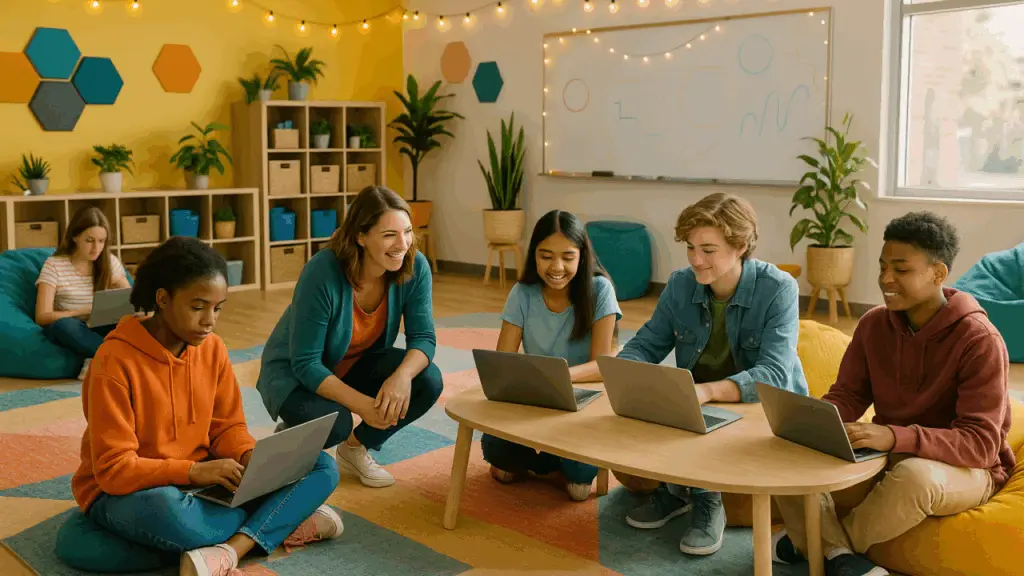
How a 2-hour mastery block closes gaps, accelerates talent, and restores Guide energy If you want different outcomes, stop worshipping the bell. Most schools still fix time and let mastery vary. 2 Hour Learning (2HL) flips that equation: mastery is fixed; time flexes. When time bends, three things happen at once—gaps close, advanced learners accelerate, and Guides get their energy back. We start with the calendar reality. The most comparable national snapshot we have shows that nine-year-old’s’ scores fell five points in reading and seven in math between 2020 and 2022—the first recorded national decline in math for this age group. That isn’t a curriculum quirk; it’s a signal that the way we allocate time isn’t catching students when they need it. Nation’s Report Card Even in 2023–24, NWEA estimates the average student needs the equivalent of ~4.8 months of additional schooling in reading and ~4.4 months in math just to reach pre-COVID benchmarks. In other words, recovery isn’t a standards problem; it’s a minutes-to-mastery problem. What 2HL is (and why it feels different) 2HL is a daily, protected 2-hour block that sits inside your regular school day. It doesn’t replace your culture—chapel, arts, athletics, electives still define your school—but it upgrades the operating system of learning. The block begins with a morning launch—not a mini-lesson, but a brief reset that centers mindset and energy for focused work: a couple of deep breaths, a posture check, and a single prompt like, “What will you master today?” Students open their mastery maps, pick a precise target, and commit. The adult in the room isn’t a lecturer; they’re a Guide. Using yesterday’s evidence—MAP Growth (3×/year) to find the big gaps and weekly mastery checks to steer the day—the Guide names a few smart starting paths. Micro-cohorts form and dissolve as students progress: no tracking, no labels, just dynamic regrouping driven by what the learner is ready for next. Inside the block, time works like a camera lens: focus sprints, short movement resets, and immediate feedback. The Guide doesn’t “teach the room”; they coach the learner—a probing question here, a quick model there, then release. Students don’t advance because the clock flipped; they advance because the evidencesays they’re ready. At the end, each student logs an artifact, marks what’s solid / what’s next, and sets a micro-goal for tomorrow. The rhythm is calm, purposeful, and personal. This isn’t trend-chasing; it’s the practical application of a research base that’s been unusually consistent for decades. Start with formative assessment—tight cycles of checking understanding and adjusting the next step. Black and Wiliam’s landmark review reported typical effect sizes between 0.4 and 0.7, far larger than many popular reforms. The reason is simple: timely feedback changes what happens next, for every learner, every day. 2HL operationalizes that loop: evidence → regroup → targeted work → evidence. Layer on active learning. When most minutes are spent doing (solving, discussing, writing, teaching back) rather than watching, outcomes move. In a broad meta-analysis, Freeman and colleagues found that active learning increased exam performance by ~0.47 standard deviations and reduced failure odds by roughly 1.5× compared with lecture-first instruction. The mechanism maps perfectly onto 2HL: attention, practice, and feedback are concentrated on the right work at the right time. 2HL also borrows the best of high-dosage tutoring—short, frequent, precisely aligned support—without standing up a separate tutoring bureaucracy. A comprehensive NBER review estimates an average ~0.37 SD impact from tutoring programs, with stronger effects when trained adults deliver tightly aligned help. The 2HL block bakes those conditions into daily school life: targeted mini-groups, frequent feedback, and alignment to clear mastery goals. What it looks like inside a 2HL block Picture a ninth-grade room at the start of 2HL. Students set their micro-goals at the morning launch—not a mini-lesson, a reset for mindset and energy: a breath, a posture check, a simple prompt like “What will you master today?” Using yesterday’s evidence, the Guidenames a few smart starting paths. Micro-cohorts form around what each learner is ready for next—some consolidating proportional reasoning, others refining slope-as-rate-of-change, a third group working on systems of equations through word problems. The room runs on focus sprints with brief movement resets. The Guide doesn’t “teach the room”; they coach the learner—circulating, conferring, spotting misconceptions early, running a short table-touch when a common error appears, then sending students back to their path. No one peels off to a separate program; the work lives inside the block. In the final minutes, every student logs an artifact, updates the mastery map, and sets a micro-goal for tomorrow. No one advances because the clock says so. No one hides in the back row. When the block ends, students transition with purpose: middle schoolers move into Life Skills(executive function, communication, financial literacy, wellness), and high schoolers dive into their Masterpiece Projects—long-horizon work that applies core skills to something real and meaningful. Why Guides feel different inside 2HL Traditional schedules exhaust adults with constant transitions and whole-class pacing that rarely fits anyone. Concentrating time around coaching and evidence tends to reduce behavior friction and replace paperwork with direct mastery artifacts. The national picture makes this shift more than a “nice idea.” RAND’s State of the American Teacher work shows managing student behavior and administrative work outside teaching ranking among teachers’ top stressors, year over year. Redesigning the day so Guides spend more minutes coaching and fewer shuffling between blocks doesn’t solve burnout on its own, but it removes two of the profession’s daily sand traps. “Isn’t this just double-dose algebra in disguise?” No—different purpose and design. Chicago’s well-known “double-dose algebra” initiative added a second daily period specifically for low-skilled 9th graders and emphasized problem solving. It was targeted remediation, and subsequent research found long-run gains in credits, graduation, and college outcomes for students near the cutoff—evidence that protected time focused on essential skills can compound into life outcomes. 2HL is universal (every student participates), mixed-ability (no tracking), and multi-subject (core Math and ELA skills driving spillover to everything else). We cite Chicago not as a blueprint, but as a proof-point that time, used strategically, moves real indicators Why families trust it Letter grades compress signal. A parent staring at “B+” can’t tell what’s mastered or what comes next. 2HL replaces ambiguity with transparent evidence. Families see the specific skills a child has secured, the ones in progress, and the next step—often with an artifact attached.
The Future of Life (and Learning)

The future of life – and learning – is progressively pixelating in my mind. I’m sharing it here not only to creatively articulate it, but to contribute to the social conversation about the impending impact of AI on our lives – and how we prepare our children. Our brain’s evolutionary impulse is to categorize everything it encounters. This tendency is the basis for memory and the related efficient navigation of our surroundings. It’s also the root of many personal misconceptions and social misunderstandings. Reality, to the extent we can agree on what that even is, tends to resist our binary categorizations: right/wrong, good/bad, us/them, etc. Most things are simply more complex or nuanced. AI is not inherently good or bad—it is rather a mirror and amplifier of human intent. How it evolves, and what it becomes, will be shaped by the values, incentives, and decisions we embed within it. We should resist the temptation to assign moral weight to the tool – and instead take responsibility for how we wield it. As human beings with evolved prefrontal cortexes – and as societies shaped by increasingly sophisticated cultural constructs – we have an obligation to transcend our primitive instinct to generalize and categorize. We’ve all heard a version of the maxim: “To whom much is given, much is expected.” And there’s no denying the intelligence fortune we’ve inherited. Our responsibility as the carriers of consciousness is both to preserve this inheritance – and to grow it. A Nod to the G.O.A.T. No serious discussion of AI’s impact on humanity should omit mention of Demis Hassabis, Co-founder and CEO of Google DeepMind. While ChatGPT has dominated headlines since its November 2022 debut, Hassabis and his team have quietly led the charge in applying AI to unlock some of the deepest structures of nature itself. Their breakthroughs are beginning to reshape the boundaries of human understanding – culminating so far in a 2024 Nobel Prize in Chemistry for solving protein folding. Many believe more Nobel-worthy discoveries are imminent. Within the next decade, DeepMind and other AI researchers will radically redefine our entire framework for understanding objective reality – from the quantum field to the cosmos at large. The impact on human life may be without historical parallel. While the printing press multiplied access to written ideas, AI multiplies access to thinking itself. It enables near-universal tutoring, translation, code generation, etc. What the steam engine did for muscle, AI is doing for mind. It will significantly alter – and potentially entirely replace – knowledge work, and thus the structure of employment, human value creation, etc. Like electricity– AI is a general-purpose technology. It is not a product but an enabler – integrated into every system and application, often invisibly but pervasively. It will underpin everything from our personal devices to national security. Theinternettransformed communication, commerce, culture, and governance. AI builds atop the internet and automates what we do with all the data it surfaced. If the internet is the Earth’s nervous system, AI is evolving into the Earth’s brain. Only the Beginning We are only at the very beginning of the exponential change in how we live – and learn. The magnitude of the coming changes will demand that each of us learn to use this technology not just competently, but creatively and productively. At the same time, we must anchor ourselves – and our children – to the high ideal of human consciousness: discernment. That is, the cultivation of judgment, critical thinking, and moral reasoning to navigate a world of increasing ambiguity, complexity, and competing claims. Discernment is not just a virtue – it’s a meta-virtue – a compass for navigating a future about which we can predict almost nothing with confidence. In every era, discernment has underpinned human flourishing. Aristotle called it phronesis – practical wisdom, the ethical application of knowledge amidst uncertainty. In spiritual traditions, discernment helped distinguish truth from illusion, the essential from the trivial. In democracies, it’s the immune system of citizenship: resisting propaganda, defending reason, sustaining governance. The central challenge of our time – perhaps of all time – is determining how we will prepare our children to flourish in an increasingly Brave New World. As every parent knows innately, we simply must not fail our children. What troubles me, therefore, is the yawning gap between the general public’s lack of understanding about what’s coming – and what reliable AI researchers like Demis Hassabis and others are publicly pronouncing. In November 2019 I watched the PBS Frontline documentary In the Age of AI and I felt a visceral urgency. I immediately joined a machine learning startup in the investment management industry and began my personal AI journey. More recently, I’ve gone all-in on our children’s future by joining 2 Hour Learning, a company revolutionizing how education is delivered in the age of AI. The company offers a unique and compelling model for how to meet our challenge: it blends personalized, AI-powered academic instruction and intentional life skill development – equipping students not only with mastery of core academic content, but with the discernment to apply it wisely. The 2 Hour Learning approach purposely cultivates the essential human traits – critical thinking, emotional intelligence, adaptability, et al – that balance-stabilize and future-proof students. The Ground of Being There’s a strong argument to be made that AI’s rise will increase the value of distinctly human experiences: presence, connection, creative expression, being in nature. I wholeheartedly agree. But as a grounding force – not an AI avoidance maneuver. The exponential acceleration of intelligence catalyzed by AI is not a phase, but a phase change. Even so, AI on its own will not determine our human destiny. What will determine it is how we humans integrate AI into our common existential project: the expansion of consciousness. In symbolic terms, the yin of human being needs to be dynamically joined to the yang of accelerated consciousness expansion in the age of AI. Viktor Frankl wrote in Man’s Search for Meaning that ultimately life asks each of us what its meaning is – and we can only answer with the lives
We Don’t Need More Hours. We Need Smarter Ones

Why are we still measuring learning in hours — when the world runs on outcomes? Think about it: Most students spend 6 to 8 hours a day in school. Add 1–3 hours of homework, and we’ve essentially built a 40+ hour workweek for children. And yet… Our students are more burned out than ever. Global benchmarks show U.S. students lagging in core subjects. And parents are left wondering: “Why is my kid doing all this… and still falling behind?” The problem isn’t effort. It’s not even curriculum. It’s how we use time. We’ve built an education system that glorifies seat time — and ignores learning time. The Time Trap of Traditional Schooling Let’s be honest: the modern school day isn’t modern at all. It’s a 19th-century structure, built for an industrial world that no longer exists. The 6–7 hour day wasn’t based on cognitive science or optimal learning — it was based on adult schedules, labor patterns, and childcare logistics. And in most classrooms today, time is still treated as the fixed variable. Learning? That’s the flexible one. If a student doesn’t get it in 50 minutes, we move on. If they get it in 10? Too bad — the clock keeps ticking. “We treat time as the fixed variable and learning as the flexible one — when it should be the opposite.” — Sal Khan, Founder of Khan Academy According to the National Center on Education and the Economy, students are engaged in actual academic learning only ~30% of the school day. That means over two-thirds of the day is transitions, classroom management, waiting, review, or content delivered too slowly to challenge most learners. Cognitive Science Says Shorter = Smarter The brain was never designed to learn in long, uninterrupted blocks. Cognitive Load Theory, developed by John Sweller, explains how our working memory can only handle a limited amount of new information at once before it starts to overload. When that happens, learning doesn’t just slow down — it stops. That’s why productivity methods like Pomodoro (25-minute work blocks) or learning techniques like spaced repetition and interleaving produce significantly better outcomes. They’re built on the idea that less time + more focus = more results. And it’s not just theory. The data backs it up: John Hattie’s meta-analysis of over 800 studies in Visible Learning found that mastery learning and formative feedback — both dependent on focused, time-limited engagement — have some of the highest effect sizes in all of education. The average effect size of extended class time? Tiny. Why? Because more time spent sitting isn’t the same as more time spent learning. The Myth of the 8-Hour Learning Day Here’s a hard truth: the 8-hour school day is a logistical artifact, not a pedagogical necessity. It was designed for factory workers, not child development. Peak cognitive alertness for kids occurs between 9:00 AM and 12:00 PM. After that? It drops. Yet we keep stacking on hours. Then we add more. Kids are expected to go home and do 2–3 hours of homework, often without support, even after spending an entire day at school. We’ve created a model where burnout is expected, joy is optional, and exhaustion is normalized. And for what? According to the OECD, U.S. students spend more time in school than nearly any other developed country — yet consistently rank mid-tier or lower in math, reading, and science. Time doesn’t equal results. Focus does. Relevance does. Retention does. “Time is a resource. It should be invested, not wasted.” — Dr. Angela Duckworth, psychologist and author of “Grit” Productivity ≠ Pressure — It’s About Purpose Here’s the biggest myth of all: If we cut time, we cut rigor. It’s simply not true. Pressure comes from poorly structured time, not short bursts of focused effort. Ask any elite athlete, musician, or entrepreneur: They don’t train all day. They train with precision, then recover. They measure outcomes, not hours. A study published in the Journal of Educational Psychology found that when instruction is designed around shorter, high-retention sessions, student anxiety dropped by 40% and retention improved significantly. Why? Because focused time builds momentum. Momentum builds confidence. Confidence builds mastery. It’s not about doing less. It’s about doing the right things — in less time — so there’s space for more of what matters. The Shift That Changes Everything Imagine a school day where core academics — reading, writing, math, science — are mastered in just 2 focused hours per day. Where no time is wasted on busywork, transitions, or one-size-fits-all pacing. Where each child moves forward based on mastery, not the clock. Where data guides instruction, and every minute matters. This isn’t theoretical. It’s happening right now in a growing number of schools using the 2-Hour Learning (2HL) model. Here’s how it works: MAP testing pinpoints exactly what each student needs. Instruction is tailored, focused, and progress is tracked daily. Students move at 2X speed, yet place in the top 1–2% nationally. There is no homework. And the rest of the day? Is finally used for what kids actually need: Purpose workshops Leadership training Financial literacy Public speaking Critical thinking AI fluency Movement and wellness Real-world connection We didn’t cut corners. We cut the waste. But What About “Rigor”? The #1 pushback we hear from traditionalists is: “If it’s shorter, it must be easier.” Let’s be clear: Rigor isn’t about how long you struggle. It’s about how deep you go. A 60-minute lecture with 80% of students bored or lost is not rigorous. A 15-minute session with personalized challenge, Socratic questioning, and feedback is. According to the Bill & Melinda Gates Foundation, the most impactful learning occurs when students engage in high-quality, intellectually demanding work — in supportive, personalized settings. That’s exactly what 2HL unlocks. We’re not dumbing it down. We’re sharpening it up. We’ve just stopped using “hours” as the currency of rigor — and started using outcomes, growth, and depth instead. Time to Stop Wasting Time The world has changed. AI can learn in seconds. Entrepreneurs build companies before 18. And kids today are growing up in a world that demands adaptability, creativity, and emotional intelligence. Yet we still anchor them to a school model built around time cards instead of potential. It’s time to stop measuring learning by the hour. It’s time to design schools around how kids actually learn — not how long they sit. That’s what we’re doing with 2-Hour Learning. We believe students don’t need more pressure.
Your kid will use AI to cheat or become a genius

The choice is yours. All technology presents a choice. For example, the internet. Many people use it to dramatically enrich their lives: building businesses, creating new revenue streams, and forging new connections that span continents. At the same time, many others use it to diminish their potential: distracting themselves into oblivion and clicking onyet another funny dog video while the greatest minds in history lie dormant at their fingertips. Technology is either a catalyst for creation or a slippery slope into intellectual erosion. AI works just the same. It will either destroy education or become the greatest learning tool ever invented. Kids will either use it to cheat or become a genius. There is no in-between. Wrongful use of AI is already infiltrating the classroom Remember when cheating required effort? When you had to slip cash to the kid who actually did the reading, or trade your lunch for the study guide with all the correct answers? Now, it only takes a few words and a prompt box. And we already know that kids are taking full advantage of this. 26% of K-12 teachers have already caught a student cheating with ChatGPT. Roughly one in ten papers are submitted containing at least 20% AI-generated content. 56% of college students have used AI on an assignment or exam. Believe it or not, I don’t think AI is the problem here. There’s a deeper issue — why do kids want to cheat in the first place? A few reasons: Kids don’t care about the material Kids feel underprepared for the material. (As well as the suffocating pressure of “getting the A,” but that’s another conversation!) Both reasons indicate something is amiss in the classroom. But in the traditional teacher-in-front-of-the-classroom model, not much can be done. Kids cannot receive the one-on-one attention they need, nor do they learn to mastery (which unlocks their motivation to learn and grow). So, most kids stay bored or fall behind. The convenient thing to do in both scenarios is reach for ChatGPT. It is not AI, but the wrongful use of AI, that is posing such a threat. And the heart, the core, the epicenter of this misuse is an educational model that does not accurately prepare or challenge kids for the future. Which means, ironically enough, AI itself can be the solution to its own problem. How AI tutors are revolutionizing education Read the full article here
How to win the AI war on writing

AI is ruining English class as we know it. Teachers are quitting, students are cheating, and overall performance is down. But AI itself is not the problem. In fact, when used correctly (or, as people like to say, “ethically”), AI could be one of the best things to ever happen to writing education. It might just elicit a writing renaissance, bringing great writing — and I mean, really great writing, the kind of juicy prose and delicious ideas that burst across your intellectual taste buds like a ripe summer peach — back into education. Because let’s be honest. It’s way overdue. Many educators, politicians, and tech bros alike think AI will give writers the boot. Thanks for your time as a writer! Happy career-hunting! But I say the opposite. AI will not make great writing obsolete. It will make it necessary. It will put it on the map. Today’s writing education mostly sucks (sorry) Writing has a notoriously terrible reputation in school. Remember the five-paragraph essay? My guess is these five paragraphs are where the initial joy of writing is often laid to rest. If we’re being honest, English class teaches you how to make your writing as boring as possible. It’s like a graveyard for play and experimentation. Students who do enjoy writing most likely do so because they enjoy reading: a novel hidden inside a textbook, a memoir devoured in the carpool line. They love writing despite English class, not because of it. Unfortunately, this boring, formulaic way of writing does not leave us in childhood. It haunts us into adulthood — specifically, the workplace. Our Slack messages and email threads sag beneath the weight of the same ole’ tired cliches. Most press releases and product announcements have all the flavor of an unseasoned chicken breast. This isn’t a knock against writers, but a testament to how traditional writing education falls short. Boring English class leads to adults who struggle to communicate anything that isn’t steeped in stuffy professionalism. No wonder AI is posing such a threat. (Who does stuffy professionalism better than ChatGPT?) Here’s why this matters. In our hyper-digital age, writing is how we communicate: texting, Tweeting, emailing, blogging, marketing — the written word is how we share our ideas with the world. (And, how we discover new ones.) If future generations want their ideas to rise above AI-generated content, then kids need to learn two things: Read the full article here
“Future-Proofing” 101

How to prepare your kids for a future that looks radically different from your past. Sixty-five percent. That’s the percentage of kids entering elementary school today who will work in jobs that don’t exist yet. It’s hard for us to wrap our heads around, isn’t it? Like trying to train for a sport without knowing the rules, the shape of the field, or whether or not it’s even played with a ball. This is the future our kids are hurtling towards. Which means, they need to be building “future-proof” skills. The familiar formula for success — study hard, get a degree, work the same job for 40 years, retire somewhere warm — is collapsing beneath the weight of technology and automation. Employees will no longer be rewarded for how long they’ve worked at the same firm or how high they’ve climbed the corporate ladder. Instead, their value will stem from their adaptability, their ingenuity, their resilience. The likelihood of your kid working the same job for forty years is low. Extremely low. Success isn’t just about working hard anymore. It’s about working smart. So, what does that look like in the classroom? How do we prepare kids for volatile job markets and unstable careers? How do we ready kids for jobs that don’t even exist yet? Four skills to future-proof your kid Dozens of leading researchers agree: the future belongs to those who are adaptive, inventive, self-driven, and emotionally intelligent. These are the skills that will define whether kids sink or swim. But let’s strip away the corporate jargon and dive into what this actually looks like. 1. Agency (Translation: Thriving in chaos) First, a definition. Agency is “an individual’s capacity to take initiative, make decisions, and exert control over their actions and environment. It’s about being proactive rather than reactive — someone with high agency doesn’t just let life happen to them; they shape it. Think of it as a blend of self-efficacy, determination, and a sense of ownership over one’s path.” To be honest, I prefer the term “ownership.” The future will not be a straight line. It will be jagged, volatile, and indifferent to our expectations. Kids need to own their actions. The ability to pivot — with swift, nimble, and proactive feet — will be the defining skill of the post-AI era. For example: it’s a random Tuesday morning in 2040. Your kid (now an adult) receives a message from their employer: their role is being phased out. It’s nothing personal. The algorithms are just better. How do they respond? Do they have the fortitude to pivot into an entirely new industry? The ability to keep their cool under pressure? The chutzpah to stay positive and ambitious in high-stress situations that don’t work in their favor? “Learned helplessness” is a psychological condition where individuals believe they have no control over the situation, so they simply give up. It starts early. In the classroom, this manifests when students experience multiple failures and thus conclude they are incapable of succeeding. Rather than thinking, “I have experienced failure,” they believe, “I am a failure.” (Big difference.) Some factors that contribute to learned helplessness in the classroom: Repeated academic failure (with little to no success mixed in) Over-scaffolding (i.e. excessive assistance from educators that prevents students from building a sense of self-confidence) Negative feedback from teachers Lack of motivation Disengagement Frustration Now that artificial intelligence is “on tap” (in the words of Gary Tan), the future is less about intellect and skill, more about grit and resilience. There is no space for victim mentalities; only action and agency. Agency is not delusional optimism, but an unshakeable sense of confidence and self-efficacy. It comes from millions of reps, of proving to yourself over and over again that you have what it takes tosimply figure it out. The world could be spinning, job markets failing, careers tanking, but those with agency will pull up their bootstraps, crack a smile, and say, “Is that all you got?” 2. Creative Problem-Solving (Translation: Thinking beyond the obvious) Tough news: we’ve gotten creativity all wrong. Many people think of creativity as a mystical trait, like an angel’s kiss bestowed at birth, and some of us just happened to be luckier than others. But that’s not the case. Creativity is a discipline. It can be taught and trained. And it remains our greatest evolutionary advantage. Creativity is defined as “the tendency to generate or recognize ideas, alternatives, or possibilities that may be useful in solving problems, communicating with others, and entertaining ourselves and others.” AI is fast, but it is not original. It can predict the next word in a sentence but not the next great idea. This is where humans win — if they are trained for it. In the paper mentioned above, there are two significant ways to “train” creative problem-solving: The mastery of knowledge In order to think creatively about a problem, students must first have a deep understanding of the problem. Knowledge opens many doors — not just generic knowledge, but specific, detailed knowledge that has been consumed to the level of mastery. The real-world application of knowledge Once students have mastered knowledge, they need opportunities to apply it. Educators must create opportunities that reflect the real-world: complex, layered, with many different routes to the desired destination. “For example, instead of asking students to find unusual uses for a paperclip, a task could challenge them to design a cost-effective and sustainable solution to a local waste management problem and giving them as much knowledge about the issue.” The equation is simple: mastery of knowledge + the real-world application of knowledge = a creative problem-solver. 3. Self-Directed Learning (Translation: The relentless pursuit of excellence) Academy Award-winner Matthew McConaughey once gave a famous speech about heroes. “My hero is me in ten years,” he said. “I’m never going to be my hero, and that’s just fine with me. It gives me someone to keep on chasing.” Safe to say, McConaughey is a self-directed learner. “Self-directed learning” happens when the student takes full ownership of their educational journey: setting goals, managing time, reflecting on their progress, pursuing excellence, and so on. They do not need