How a 2-hour mastery block closes gaps, accelerates talent, and restores Guide energy
If you want different outcomes, stop worshipping the bell. Most schools still fix time and let mastery vary. 2 Hour Learning (2HL) flips that equation: mastery is fixed; time flexes. When time bends, three things happen at once—gaps close, advanced learners accelerate, and Guides get their energy back.
We start with the calendar reality. The most comparable national snapshot we have shows that nine-year-old’s’ scores fell five points in reading and seven in math between 2020 and 2022—the first recorded national decline in math for this age group. That isn’t a curriculum quirk; it’s a signal that the way we allocate time isn’t catching students when they need it. Nation’s Report Card Even in 2023–24, NWEA estimates the average student needs the equivalent of ~4.8 months of additional schooling in reading and ~4.4 months in math just to reach pre-COVID benchmarks. In other words, recovery isn’t a standards problem; it’s a minutes-to-mastery problem.
What 2HL is (and why it feels different)
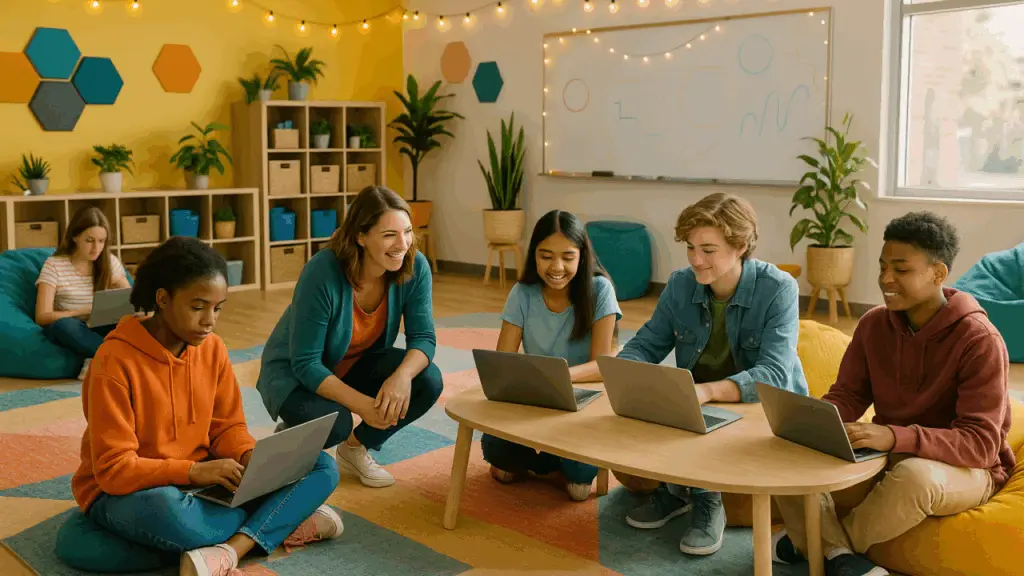
2HL is a daily, protected 2-hour block that sits inside your regular school day. It doesn’t replace your culture—chapel, arts, athletics, electives still define your school—but it upgrades the operating system of learning. The block begins with a morning launch—not a mini-lesson, but a brief reset that centers mindset and energy for focused work: a couple of deep breaths, a posture check, and a single prompt like, “What will you master today?” Students open their mastery maps, pick a precise target, and commit. The adult in the room isn’t a lecturer; they’re a Guide. Using yesterday’s evidence—MAP Growth (3×/year) to find the big gaps and weekly mastery checks to steer the day—the Guide names a few smart starting paths. Micro-cohorts form and dissolve as students progress: no tracking, no labels, just dynamic regrouping driven by what the learner is ready for next.
Inside the block, time works like a camera lens: focus sprints, short movement resets, and immediate feedback. The Guide doesn’t “teach the room”; they coach the learner—a probing question here, a quick model there, then release. Students don’t advance because the clock flipped; they advance because the evidencesays they’re ready. At the end, each student logs an artifact, marks what’s solid / what’s next, and sets a micro-goal for tomorrow. The rhythm is calm, purposeful, and personal.
This isn’t trend-chasing; it’s the practical application of a research base that’s been unusually consistent for decades. Start with formative assessment—tight cycles of checking understanding and adjusting the next step. Black and Wiliam’s landmark review reported typical effect sizes between 0.4 and 0.7, far larger than many popular reforms. The reason is simple: timely feedback changes what happens next, for every learner, every day. 2HL operationalizes that loop: evidence → regroup → targeted work → evidence.
Layer on active learning. When most minutes are spent doing (solving, discussing, writing, teaching back) rather than watching, outcomes move. In a broad meta-analysis, Freeman and colleagues found that active learning increased exam performance by ~0.47 standard deviations and reduced failure odds by roughly 1.5× compared with lecture-first instruction. The mechanism maps perfectly onto 2HL: attention, practice, and feedback are concentrated on the right work at the right time.
2HL also borrows the best of high-dosage tutoring—short, frequent, precisely aligned support—without standing up a separate tutoring bureaucracy. A comprehensive NBER review estimates an average ~0.37 SD impact from tutoring programs, with stronger effects when trained adults deliver tightly aligned help. The 2HL block bakes those conditions into daily school life: targeted mini-groups, frequent feedback, and alignment to clear mastery goals.
What it looks like inside a 2HL block
Picture a ninth-grade room at the start of 2HL. Students set their micro-goals at the morning launch—not a mini-lesson, a reset for mindset and energy: a breath, a posture check, a simple prompt like “What will you master today?” Using yesterday’s evidence, the Guidenames a few smart starting paths. Micro-cohorts form around what each learner is ready for next—some consolidating proportional reasoning, others refining slope-as-rate-of-change, a third group working on systems of equations through word problems.
The room runs on focus sprints with brief movement resets. The Guide doesn’t “teach the room”; they coach the learner—circulating, conferring, spotting misconceptions early, running a short table-touch when a common error appears, then sending students back to their path. No one peels off to a separate program; the work lives inside the block. In the final minutes, every student logs an artifact, updates the mastery map, and sets a micro-goal for tomorrow. No one advances because the clock says so. No one hides in the back row.
When the block ends, students transition with purpose: middle schoolers move into Life Skills(executive function, communication, financial literacy, wellness), and high schoolers dive into their Masterpiece Projects—long-horizon work that applies core skills to something real and meaningful.
Why Guides feel different inside 2HL
Traditional schedules exhaust adults with constant transitions and whole-class pacing that rarely fits anyone. Concentrating time around coaching and evidence tends to reduce behavior friction and replace paperwork with direct mastery artifacts. The national picture makes this shift more than a “nice idea.” RAND’s State of the American Teacher work shows managing student behavior and administrative work outside teaching ranking among teachers’ top stressors, year over year. Redesigning the day so Guides spend more minutes coaching and fewer shuffling between blocks doesn’t solve burnout on its own, but it removes two of the profession’s daily sand traps.
“Isn’t this just double-dose algebra in disguise?”
No—different purpose and design. Chicago’s well-known “double-dose algebra” initiative added a second daily period specifically for low-skilled 9th graders and emphasized problem solving. It was targeted remediation, and subsequent research found long-run gains in credits, graduation, and college outcomes for students near the cutoff—evidence that protected time focused on essential skills can compound into life outcomes. 2HL is universal (every student participates), mixed-ability (no tracking), and multi-subject (core Math and ELA skills driving spillover to everything else). We cite Chicago not as a blueprint, but as a proof-point that time, used strategically, moves real indicators
Why families trust it
Letter grades compress signal. A parent staring at “B+” can’t tell what’s mastered or what comes next. 2HL replaces ambiguity with transparent evidence. Families see the specific skills a child has secured, the ones in progress, and the next step—often with an artifact attached. “How was school?” turns into “Show me what you learned today.” Confidence tends to rise when the conversation is about demonstrated mastery, not points accumulated.
Why it fits mission-driven private schools
Independent schools rightly protect their identity: tradition, community, the whole-child promise. 2HL fits that posture. It doesn’t bulldoze sacred rhythms; it modernizes outcomes while those rhythms remain intact. In practice, schools deploy 2HL as a daily engine for core skills—Math and ELA first—so that seminar, studio, lab, and the stage are powered by stronger fundamentals. The brand promise becomes both human and measurable: every child moves forward—no ceiling for acceleration, no gap ignored.
The guts that make it work
Think of 2HL as precision engineering for learning time:
- Evidence at two tempos. Three times a year, universal measures (e.g., MAP Growth) surface patterns and gaps; weekly micro-checks steer regrouping inside the block. The combination catches both the macro “where are we” and the micro “what’s next.” The need is real: by the end of 2023–24, NWEA still estimates ~4.8 months to catch up in reading and ~4.4 in math for the average student. 2HL exists to convert those months into learning, not lost time. NWEA
- Guides, not lecturers. The adult’s job is precision coaching—asking better questions, spotting misconceptions early, and releasing students to apply strategies.
- Dynamic grouping without stigma. Micro-cohorts form and dissolve based on current skill; students move fluidly across paths as evidence changes.
- Mastery maps with artifacts. Progress is visible and portable; reporting becomes “what’s solid / what’s next,” which travels better than a percentage in a gradebook.
- Sprints + resets. Attention is a resource. Short movement resets protect it so the next sprint is productive.
The leadership takeaway
If your school wants to honor tradition and outperform your past, don’t ask for more hours—reassign the ones you already have. A 2-hour mastery block turns schooling minutes into learning minutes by aligning time with how humans actually learn: clear goals, focused practice, frequent feedback, and adult guidance aimed where it moves the needle. The post-COVID landscape demands that kind of precision. The gaps were measured; the remedy is design. Two hours, done right, will close what matters, uncap students ready to fly, and give Guides a day that honors their craft.
And because the schedule is the message, here’s ours: stop moving kids by the bell; start moving them by evidence. When time bends to mastery, schools become what they were always meant to be—places where every student moves forward, every day.